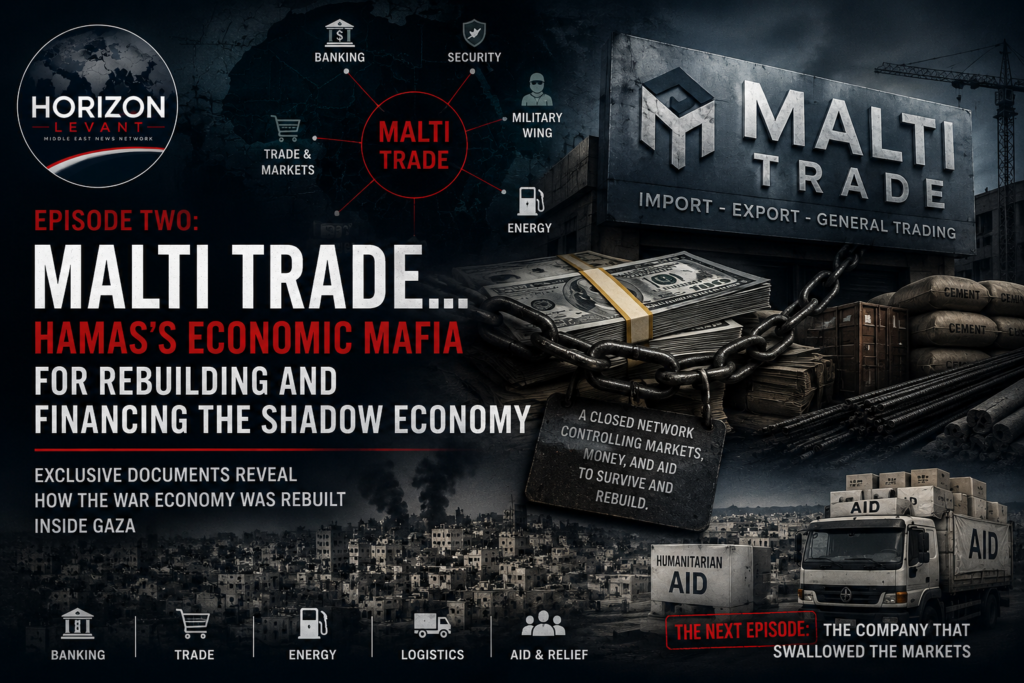
Horizon Levant continues to expose the network.
In the first episode, we entered the heart of Hamas’s financial system. Today, we open a darker door: the door that leads from financial decision-making to the market, from the market to money, and from money to rebuilding the network. The name of that door is “Malti Trade.”
This is not the story of a company looking for profits in a crowded market, nor is it a tale of businessmen competing over cement, steel, gas, and food supplies. The documents underpinning this investigation paint a more dangerous picture: a company that, according to the available information, has become one of the most important economic fronts within the shadow economy associated with Hamas, and a tool through which money can be recycled, markets controlled, competitors weakened, and new sources of financing secured.
According to this picture, it is not merely a company within Hamas’s economy, but part of the economy that allows Hamas to rebuild itself economically after the war. When the military infrastructure is hit, the movement needs more than men and weapons. It needs money, companies, markets, supply chains, and channels through which it can move funds and goods away from the formal economy.
This is where “Malti Trade” emerges. A company on the surface, a network behind the scenes. And the question this episode will pursue to the very end is not: What does “Malti Trade” sell? It is: Where does the money come from? Where does it go? And who benefits when the company swallows one market after another?
Mohammed Ghanem… The Man of Money at the Heart of the Company
Mohammed Ghanem chairs the board of directors of “Malti Trade.” But Ghanem is not merely the chairman of a commercial company. He is a representative of Hamas’s Banking and Financial Committee.
And this is where the story begins to take a different shape. Because the man sitting at the head of a company operating in the markets is himself linked to the committee responsible for the movement’s banking and financial affairs. In other words, the dividing line between the company and the financial apparatus becomes blurred, and money, in this case, does not move in a vacuum. It moves through a network of people, companies, and relationships.
Ghanem’s deputy is Mohammed Al-Sarraj, whom the available information identifies as a representative of his brother, Sameh Al-Sarraj, known as “Abu Fikri,” who is described as being responsible for the security apparatus and what is known as “national security” at the movement and organizational level, as well as within its military wing, the Al-Qassam Brigades.
A commercial company, then, has at its top a man linked to the financial apparatus, alongside a representative of a security circle, according to the information underpinning the investigation. At this point, the matter is no longer simply about commerce.
A Board of Directors That Looks Like a Map of Hamas’s Economy
The circle widens further with the remaining members of the board.
Khaled Al-Husri, the son of the head of Hamas’s affiliated Chamber of Commerce and the brother of the director of the Islamic National Bank, against whom the file contains allegations and cases involving corruption.
Then there is Salim Abu Kamil, the representative of the Al-Qassam Brigades within the company and brother of “Al-Habra” Abu Kamil, who, according to the information cited in the investigation, became known through corruption files dating back to the era of Ahmed Al-Jabari and served as his personal escort.
Then Dr. Mohammed Al-Jaghlab, an accountant from Khan Younis, who is considered close to the circle surrounding Mohammed Sinwar.
Then Wissam Al-Hassan, “Abu Al-Saeed,” known as “Al-Janji,” who, according to the available information, is responsible for the economic portfolio, specifically oil and gas, within the movement.
Put these names in one room, then ask yourself: Are we looking at an ordinary board of directors?
Banking, commerce, economics, security, a military wing, and energy. According to the documents, all these threads converge at the same company. This is not merely a coincidence in names. It is the structure that allows the company to operate across more than one market at the same time.
From Telecommunications to Gas… The Network Leaves No Financial Artery Untouched
Mohammed Ghanem did not operate alone. His brother, Mazen Ghanem, owner of the “Ghanem Phone” chain across the Gaza Strip, appears in the telecommunications file.
The information indicates that he is linked to the manufacturing portfolio within the Al-Qassam Brigades, and that his brother’s influence was used to participate in controlling the telecommunications market.
In this chain, Mohammed Abu Dayr, financed by Fathi Hammad, a member of Hamas’s political bureau, also appears, alongside Al-Malash Company, owned and managed by the children of Ismail Haniyeh’s sister, the former head of the movement.
The map therefore expands. Telecommunications are not separate from commerce. Commerce is not separate from money. And money is not separate from influence. Every sector can become a new source of income, and every market can become another link in the shadow economy.
According to these findings, the project is not about owning a single company. The project is about owning the keys to the markets.
Murabaha… When Financing Becomes a Path to Monopoly
The official face of “Malti Trade” looks entirely ordinary: cement, steel, sugar, flour, and rice. But according to the information underpinning the investigation, the company’s real face emerges when we examine the relationship between this trade and the banks.
A trader who receives Murabaha financing from Hamas-affiliated banks, including the Islamic National Bank and the Production Bank, is forced to purchase his goods from “Malti Trade.”
Here, Murabaha financing transforms from a mere financing instrument into something resembling a compulsory gateway to the market. The bank provides the financing, the trader receives the money, the company supplies the goods, and the money returns to the same cycle.
The matter therefore goes far beyond an ordinary commercial relationship. It is a closed financial circuit. And a closed circuit is one of the most powerful tools of a shadow economy because it allows money to circulate within a defined network instead of being naturally distributed among competitors.
The network, therefore, does not need to announce a monopoly. It can simply make competition unavailable.
Oil and Gas… This Is Where the Real War for the Market Begins
Then “Malti Trade” entered the oil and gas market. According to the information contained in the file, the objective was not merely to compete with existing companies, but to replace them: eliminate the old companies, weaken independent operators, and then introduce companies connected to the network.
The method was clear: inducement for those who accepted, intimidation for those who refused. Someone facing financial difficulties at his station could be offered assistance in exchange for a partnership. Those who refused could find themselves facing arrest, political extortion, fabricated accusations, and the use of security agencies to eliminate competitors.
We are not talking about a businessman trying to win a tender. We are talking about redrawing an entire market by force.
Abu Asi Station… When Refusing to Sell Becomes Costly
The most striking story in this part begins with a station that was under construction and in the licensing process for its owner, engineer Hisham Sharaf, through “Sharaf Company.”
Sharaf was subjected to pressure and impossible demands through Dr. Mohammed Al-Mughair, the head of security and safety at Hamas’s Civil Defense, who, according to the information, is considered part of the “Malti Trade” circle.
But Sharaf refused to sell. He was then arrested. Afterward, he was forced to sell the station to the Production Bank through Rami Abu Shaaban.
But Abu Shaaban’s name later appears in the file as well. The information indicates that a committee from Yahya Sinwar’s office subsequently investigated him, and that he was dismissed over corruption.
After the station changed hands, Abu Asi Company emerged in the gas market. Its nominal owner was Hussein Abu Asi, the former attorney general under the Palestinian Authority.
Its management, however, is attributed to his son, Assem Abu Asi, a former captain of the Palestine national team, who, according to the information, was listed on the Preventive Security payroll and assigned to Jibril Rajoub’s office, while his wife was listed with President Mahmoud Abbas’s office.
Here, the story becomes even more controversial because, according to the documents, the names transcend the political divisions that appear clearly on the surface. When it comes to money and the market, a network emerges that is far more complicated than slogans and affiliations.
Cheap Gas… The Weapon That Fires No Bullet
Abu Asi Company offered gas at low prices, with the aim of breaking competitors and then purchasing them later. At the same time, the file describes the company as a vehicle for money laundering.
During the three years preceding the war, the information cited in the investigation indicates that oil companies suffered enormous losses.
On the surface, a low price appears to benefit the consumer. But what happens if the low price is part of a plan to bankrupt a competitor?
At that point, the price is no longer a tool of competition. It becomes an economic weapon. It does not kill a competitor with a bullet. It kills it through losses, then buys whatever remains.
According to the investigation, this was one of the mechanisms that reshaped the gas market.
Sabra Company… The Same Scenario Returns
The story did not end with Abu Asi. The same mechanism was repeated with Sabra Gas Company, known as the Eastern Line and owned by Dr. Sabra.
The person appearing at the center of the operation is Munther Haboush, “Abu Jamal,” one of the Al-Qassam intelligence officials in Gaza, described as the “black box” and a man personally very close to Mohammed Ghanem.
Again: an independent company, pressure, influence, then an attempt at replacement.
If the scene was repeated across two companies, the question is no longer about an isolated incident. The question becomes: Was there an organized project to reshape the entire gas market?
The War… When Aid Entered the Shadow Economy
Then came the war, ushering in the harshest stages of Gaza’s economy. At this point, according to information obtained by the investigation, “Malti Trade” became a vehicle for collecting aid.
The name that appears here is Rami Al-Ghazali, Mohammed Ghanem’s brother-in-law, who resides in Gaza. He collected aid from abroad, supplied it to the Strip, and then sold it in the markets.
And here we reach the most dangerous point in the story.
Because this time, the commodity is not cement. It is not gas. It is not steel.
It is aid.
Money sent to provide relief to people can become part of a commercial cycle that generates revenue within a wartime economy.
In a society living under bombardment, hunger, and displacement, controlling aid becomes a form of control. Whoever controls what enters the market controls part of the market. And whoever controls aid controls more than the market.
When Money Is Not Enough… Pressure Takes Over
But the shadow economy does not protect itself with money alone. There is media, there are campaigns, and there are threats.
We documented organized campaigns of threats and media extortion against traders aimed at forcing them to enter into power-sharing arrangements.
More strikingly, these campaigns did not remain inside Gaza. Activists were recruited in Amman, Turkey, Egypt, Indonesia, and Mauritania to manage pressure campaigns remotely.
The pressure network itself therefore became transnational.
The trader is in Gaza, but the pressure may come from Amman, Turkey, Egypt, Indonesia, or Mauritania.
The market is local. The network is not.
Conclusion… The Company That Wants the Market to Rebuild the Network
When we bring these threads together, the image of “Malti Trade” changes completely.
We are no longer looking at a company that sells cement and steel.
We are looking at a name appearing across banking, food supplies, telecommunications, petroleum, gas, fuel stations, aid, and pressure campaigns.
According to the documents underpinning the investigation, these sectors are not isolated islands. They are components of a single cycle: financing opens the way, the company supplies the goods, the market generates profits, influence protects the market, the money is recycled within the network, and then the cycle begins again.
And here lies the most dangerous idea in this file:
Hamas does not necessarily need to rebuild its old economy in its old form.
It can build another economy, one that is less visible and more flexible, based on companies rather than official institutions, networks rather than a treasury, the market rather than a budget, and a war economy rather than a normal economy.
From this perspective, “Malti Trade” becomes more than a company. It is one of the fronts through which Hamas’s dark economy appears.
An economy capable of raising money, moving goods, recycling profits, controlling markets, and creating new sources of financing.
And the ultimate objective, as these threads reveal, is not merely profit.
The objective is survival.
And survival means rebuilding the network.
Rebuilding the network means money.
And money means the ability to return.
That is why the story of “Malti Trade” does not end in Gaza, nor does it end with the company itself.
It begins there.
In the next episode, we move beyond the company’s façade to the layer behind it: the money, relationships, and figures operating outside the Strip, and the threads connecting Gaza’s local shadow economy to a much broader network.
The names that have appeared here are only the part the light has allowed us to see.
The most controversial part is still in the dark.